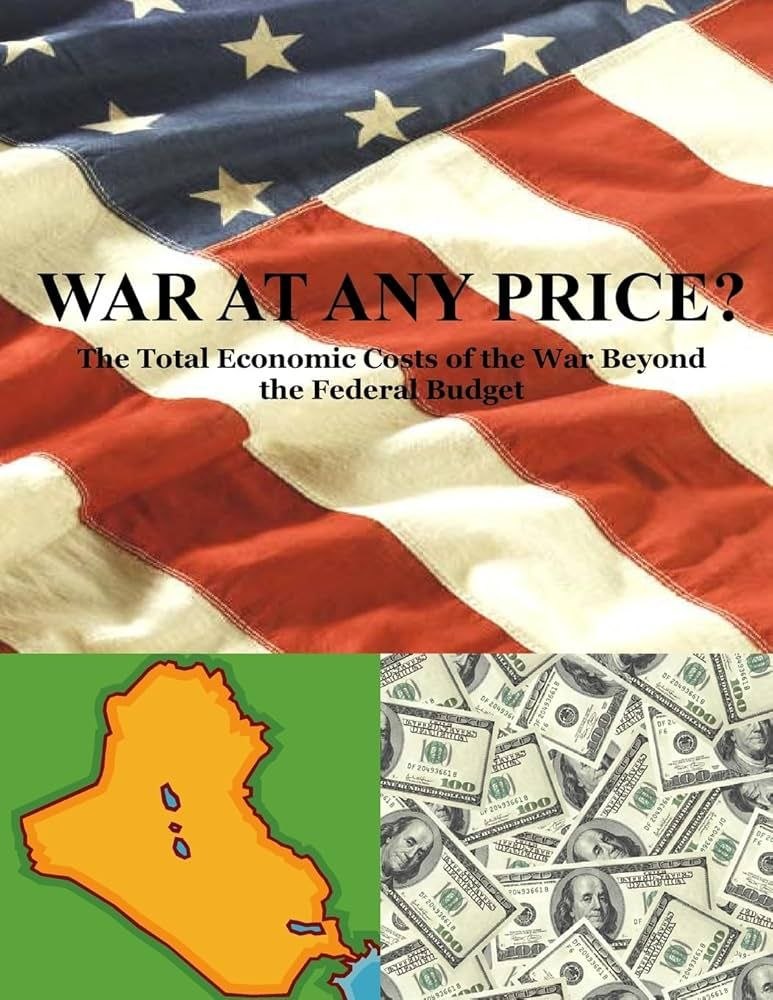
War at Any Cost?
The Joint Economic Committee (JEC) – One of the standing committees of the U.S. Congress, composed of both Senators and Representatives from both political parties. Its role is to review economic conditions and recommend improvements to economic policy.
The hearing took place during the One Hundred Tenth Congress, Second Session (which met from January 2008 to January 2009). The presiding members included prominent economists and legislators such as Senator Charles Schumer (D-NY) and then-Representative Maurice Hinchey (D-NY).
The “Book” (Official Government Hearing)
Title: War at Any Cost? The Total Economic Costs of the War Beyond the Federal Budget
Format: This is a transcript of a congressional hearing, not a traditional book. It was published by the U.S. Government Printing Office (GPO) and is part of the official congressional record.
Context & Date: The hearing was held during the second session of the 110th Congress (2008). At that time, the United States was actively engaged in the Iraq War (started 2003) and the war in Afghanistan. The Bush administration had funded these wars through “supplemental appropriations” outside the regular federal budget, leading critics to argue that the true costs were hidden.
Purpose of the Hearing: The title asks a rhetorical question: War at Any Cost? The goal was to investigate and calculate the total economic burden of the wars in Iraq and Afghanistan — including costs that do not appear in the official Department of Defense budget.
Key Topics & Arguments:
The hearing moved beyond the standard “Pentagon budget” and examined hidden or indirect costs, such as:
1. Interest on Debt: Borrowed money used to finance the wars, plus future interest payments to foreign and domestic bondholders.
2. Veterans’ Healthcare & Disability: Long-term medical care, mental health treatment (PTSD, TBI), and disability compensation for decades after combat ends.
3. Replacement of Equipment: Cost of repairing or replacing worn-out or destroyed military hardware (tanks, helicopters, vehicles).
4. Economic Opportunity Costs: What the hundreds of billions of dollars could have been spent on domestically (e.g., infrastructure, education, healthcare, tax cuts).
5. Impact on Oil Prices & Global Economy: Disruptions to Middle Eastern oil supplies and the macroeconomic ripple effects.
6. State & Local Costs: Expenses borne by states and municipalities for returning soldiers (e.g., National Guard activation, re-integration programs).
Witnesses (Experts Testifying): The hearing featured testimony from leading economists and scholars, most notably:
· Joseph E. Stiglitz (Nobel Prize-winning economist, Columbia University)
· Linda J. Bilmes (Harvard University economist, co-author with Stiglitz of The Three Trillion Dollar War)
Their testimony presented the now-famous estimate that the true total cost of the Iraq War would exceed $3 trillion — far higher than the Bush administration’s official figures (which were around $500–800 billion at the time).
Conclusion of the Hearing: The committee members and expert witnesses largely concluded that the full economic costs were dramatically understated by the executive branch. The hearing argued that by ignoring long-term obligations (veterans’ care, debt interest), the government was misleading the public about the true price of war, and that fiscal transparency was essential for democratic accountability.
Significance: This hearing was a landmark moment in moving the public debate from “how much are we spending on bombs today?” to “what is the total, multi-decade impact on the U.S. economy and future generations?” It directly influenced subsequent budget scoring rules and continues to be cited in discussions of the long-term costs of military conflict.
How to Find It: You can locate the full PDF on official government websites like GovInfo.gov (search by title or the committee name and Congress number) or via academic databases like ProQuest Congressional.