The South China Morning Post reports that half of Thailand’s fishing fleet is already docked, with diesel prices up more than 30% since the U.S. struck Iran. Fishermen are absorbing record fuel costs while middlemen refuse to pay more for their catch. The National Fisheries Association warns the entire US$7 billion sector could “collapse like dominoes.” It’s a heartbreaking story – but the mainstream media misses the real culprit.
This isn’t just about supply and demand. This is about an unconstitutional war Iran never asked for, launched without a single congressional vote, and bankrolled by US tax dollars funding Israel to the tune of billions. The Trump Israel Iran war has caused global energy chaos, but the hidden angle is the deliberate profiteering built into the system.
Follow the money. According to the Costs of War Project at Brown University, the United States has spent or obligated $8 trillion on post-9/11 wars – and the Iran conflict alone is burning through an estimated $1 billion to $2 billion per day. Meanwhile, OpenSecrets reports that the defense industry spent $2.6 billion on lobbying over the past two decades to ensure the bombs keep flowing. Lockheed Martin’s stock rose 33% in the first two months of 2026 alone. The CEOs of these companies met with President Trump to “quadruple production” of weaponry – while Thai fishermen watch their livelihoods sink.
Congress never voted to authorize this war. A Senate War Powers Resolution demanding consent failed on a 47-53 vote. The Constitution’s Article I, Section 8 grants Congress – not the president – the sole power to declare war. Yet on February 28, 2026, Trump ordered U.S. forces to join Israel in preemptive strikes.
So why isn’t Congress debating this? Tell your representative to bring the troops home and stop the war profiteering. Share this if you want your tax dollars spent at home, not on bombs that destroy livelihoods halfway around the world.
Source: South China Morning Post – reprinted for commentary and analysis under fair use. The following is the original reporting:
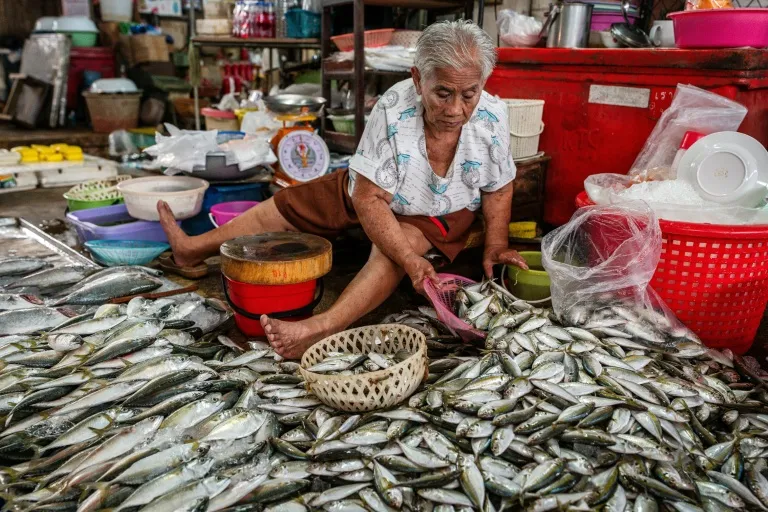
A dawn gloom hangs over the pier in Bangsaray, eastern Thailand, as buyers arrive to wait for the first fishing boats to return. But like everyone else relying on the day’s catch they have already lost money to someone else’s war.
Thailand’s multibillion-dollar fishing industry has been brought to its knees by the runaway price of diesel, a result of Iran’s throttling of the Strait of Hormuz in response to the US and Israel’s attacks.
Half of the kingdom’s vast fishing fleet is already docked, according to the National Fisheries Association of Thailand, which warns that without government intervention the remainder will soon follow: a potential cataclysm for a sector employing hundreds of thousands, from deep-sea fishers to high-end restaurants.
But the mini-economy on Bangsaray pier, Chonburi province, is staggering on, for now – even as US President Donald Trump vacillates over the next steps in a war he started.
Boat owners say they are shouldering the record cost of the diesel required to power the fleet, which last week pushed beyond 45 baht (US$1.38) a litre, more than 30 per cent higher than pre-war levels. And they still have salaries to pay.
The middlemen who drive between the piers to buy catch for sale at market said that inflated transport costs had withered profit margins to around US$1 per kilogram of fish.
Even the delivery companies providing the ice that keeps the fish fresh for restaurants and wholesalers are struggling to break even. With the Iran war pushing the price of a barrel of benchmark Brent crude beyond US$100, the cost of simply filling up a truck with fuel has become prohibitive.
“We can’t leave out boats at dock, wages have to be paid either way,” said small-boat owner Udom Jittanom, surrounded by crates brimming with squid so fresh that their cells still flushed red in a final flicker of life.
“So we keep going out, selling what we catch and hoping fuel costs come down. But raising prices? No chance, the middlemen won’t hear it. They pass their costs on to consumers. We just have to absorb it.”
The buyers on the pier rejected that equation, claiming they were equally squeezed by restaurants whose customers demand seafood but stay at home when prices rise.
Appetite for seafood
Thailand is one of the world’s leading seafood producers. Its tinned tuna and frozen shrimp are sold in supermarkets across the globe, with the US, Japan and China as the top buyers.
Fishery exports were valued at more than US$7 billion in 2024, the latest year for which government figures are available and the highest level in a decade.
Competition from Vietnam has chipped away at prices, however, while Thai fishing firms say that onerous labour laws introduced to address the “slavery-at-sea” scandal that plagued the sector for years have further thinned margins.
Some dark spots remain, but labour rights groups say Thailand has made strides in ensuring salaries are paid in cash rather than in kind, guaranteeing days off and curbing the once-rampant abuse of vulnerable migrant workforces from Myanmar, Cambodia and Laos.
Yet even those fishers who were keen to see the authorities clean up a sector that had previously been notorious for the mafia-style control of certain Thai ports said the new regulations had eaten into the profits of multigenerational family businesses.
The industry could ill afford a fresh crisis, but Trump’s war on Iran delivered one anyway.
“Seafood prices were already falling. Now you add a fuel crisis on top of that and the whole sector collapses like dominoes,” National Fisheries Association of Thailand president Trailerk Muesantad, 63, told This Week in Asia. “We’re talking about hundreds of thousands of workers – fishermen, fish market traders, fishmeal factories, processing plants. If the boats stop, all of that stops.”
Barely breaking even
At the Bangsaray pier – small when compared to the major Thai fishing hubs of Rayong and Samut Sakhon – the daily catch is mainly destined for the domestic market, which in coastal Chonburi is supercharged by the appetites of millions of tourists.
But the size of the catch itself is shrinking, as warming oceans kill off species, while industrial-scale bottom-trawling by larger vessels indiscriminately scoops up juveniles far out to sea, depleting populations closer to shore.
Fishing boats must consequently make longer journeys to find fish, consuming even more fuel.
A 50-tonne capacity vessel, mid-size for the Thai fleet, uses around 2,000 litres (530 gallons) of fuel over two weeks. Last year, that would have cost around 40,000 baht. Now, the price has doubled.
While a successful day at sea can net about 50,000 baht, thin margins are quickly erased by maintenance and monthly crew salaries of 15,000 baht per member, according to one boat owner.
“We are just about covering costs and salaries,” said the owner, requesting anonymity. “If fuel rises to 60 baht a litre then we will have to dock. We won’t be stubborn, we’ll just stop because we’d be fighting a losing battle.”
The Thai government has been inundated with pleas for fuel subsidies, but late last month it was forced into a phased withdrawal of support as its Oil Fuel Fund began burning through tens of millions of dollars a day.
Even if Trump declares an end to America’s involvement in the war, Thailand’s government is pricing in months of unpredictability, anticipating that restrictions on fuel supplies passing through the Strait of Hormuz will remain.
Thai officials are pushing the use of B20, a cheaper biodiesel blend of diesel and refined palm oil, to help offset the knock-on costs of a far-off war on the country’s fishing industry.
But Thailand ultimately has no control over the timeline of a Middle Eastern conflict.
“This is worse than the Covid pandemic,” said Trailerk, the fisheries association president. “Then the situation was uncertain but stable. This is volatile in a way I’ve never seen. When we go under, it won’t just be us – it’ll be everyone connected to this industry.”