While AP reports that companies are now shelling out as much as $4 million for a single Panama Canal crossing thanks to the Hormuz chokehold, the mainstream media misses the real story. This isn’t just about supply chain chaos – it’s about the Trump Israel Iran war lining the pockets of the same profiteers who have spent decades dragging American families into endless Middle East wars.
Let’s be clear: this is an unconstitutional war Iran never provoked, launched without a single congressional vote. And while giant shipping firms argue over auction fees, who profits from war? According to the Costs of War Project at Brown University, post-9/11 US wars have cost taxpayers $8 trillion – enough to have rebuilt America’s infrastructure twice over. The Iran war alone is burning through an estimated $1-2 billion per day. OpenSecrets reports that the defense industry spent $2.6 billion on lobbying over two decades to ensure endless conflict. Lockheed Martin’s stock rose 33% in early 2026 as the war escalated.
Meanwhile, US tax dollars funding Israel continue to flow at $3.8 billion annually – money that directly subsidizes the strikes that closed the Strait of Hormuz. And now, American consumers are paying the price. Every time you buy a car, a smartphone, or a bag of grain, you’re funding a war tax that the wealthy pass directly to you. The $4 million fee? That’s baked into the price of everything on the shelf.
The Panama Canal Authority is “maximizing what it can earn,” and oil companies are paying millions to jump the queue – but they’re not the ones who will suffer. You are. Your family is.
So why isn’t Congress debating this? Tell your representative to bring the troops home and stop the endless funding. Calculate your war tax here – then ask yourself: what could that money have bought for your children?
Source: Associated Press – reprinted for commentary and analysis under fair use. The following is the original reporting:
Businesses Spend Up To $4 Million To Cross Panama Canal Amid Hormuz Chokehold
Panama City:
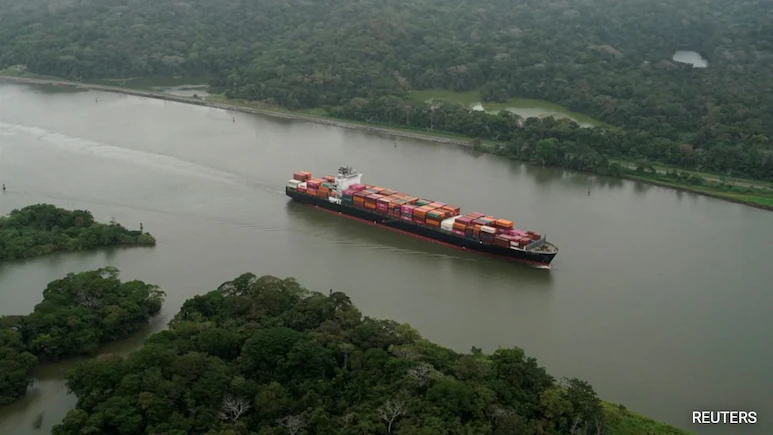
Businesses have doled out as much as $4 million for last-minute plans to move boats through the Panama Canal in recent weeks, the Panama Canal Authority says, as Iran war’s effective closure of the Strait of Hormuz generates a seismic shift in global trade flows.
While passage through the canal usually comes at a flat rate via reservations, companies without bookings can pay more to cross through an auction that awards slots to the highest bidder. The alternative would be waiting for days off the coast of Panama City.
The demand for slots skyrocketed and the auction prices ballooned in recent weeks as a standoff between the Iran and the United States over access to the strait kept traffic bottlenecked. Commercial vessels increasingly have traveled through the Panama Canal carrying shipments that were rerouted or purchased from different countries to avoid the waterway off Iran’s coast.
“With all the bombings, the missiles, the drones … companies are saying it’s safer and less expensive to cross through the Panama Canal,” said Rodrigo Noriega, a lawyer and analyst in Panama City. “All of this is affecting global supply chains.”
Meanwhile, Panama’s government is “maximizing what it can earn from the Panama Canal,” Noriega said.
The average price to cross through the canal ranges between $300,000 and $400,000 depending on the vessel. Previously, to get an earlier crossing, businesses would pay an additional $250,000 to $300,000. In recent weeks, the average additional cost has jumped to around $425,000.
Normally, about 6% of global trade passes through the Panama Canal, which connects the Atlantic and Pacific oceans in Central America, according to Patrick Penfield, professor of supply chain practice at Syracuse University. The canal has recovered from several years of drought, he added.
Goods like car parts, grain and consumer electronics being shipped from China to Europe or vice versa, or from China to the U.S. East Coast, pass through the canal.
Some oil passes moves through the Panama Canal, but it isn’t a viable large-scale alternative to the Strait of Hormuz because of its size. The largest ships that carry oil, known as ultra-large container vessels, are too big for the canal.
Ricaurte Vásquez, the canal’s administrator, said one company that he would not name paid an extra $4 million when its fuel vessel had to change its destination because of ongoing geopolitical tensions.
“It was a ship carrying fuel to Europe, and they redirected it to Singapore, and it needed to get there because Singapore is running out of fuel,” he said.
Other oil companies paid an excess of $3 million in addition to the crossing fee to accelerate their passage in the face of soaring oil prices.
The extra fees are becoming so high not because ships are piling up at the canal, but rather because of last-minute shifts and greater urgency for vessels to pass through in the wake of broader trade chaos, Vásquez said. He emphasized that these costs were temporarily being shouldered by companies based on their level of urgency.
“They decide how high to go on the price,” Vásquez said.
At the same time as Panama’s government is earning more money from the newly brisk business in the canal, its shipping industry is being confronted by the geopolitical struggle in the same way as those of other countries.
Panama’s foreign ministry on Wednesday accused Iran of illegally seizing a Panama-flagged vessel from the Italian company, MSC Francesca, in the Strait of Hormuz. Panama, which has one of the world’s largest ship registries, said the ship was “forcibly taken” by Iran. It wasn’t immediately clear if the boat remained in Iranian custody.
“This represents a serious attack on maritime security and constitutes unnecessary escalation at a time when the international community is advocating for the Strait of Hormuz to remain open to international navigation without threats or coercion of any kind,” it said.
Noriega, the analyst, said that the amount companies are paying to cross the Panama Canal may continue to go up if the conflict stretches on, as oil prices are already skyrocketing. The price of a barrel of Brent crude oil briefly jumped above $107 this week, soaring from around $66 a barrel a year ago.
Nobody expected the war to have quite so much effect on global trade, Noriega said.