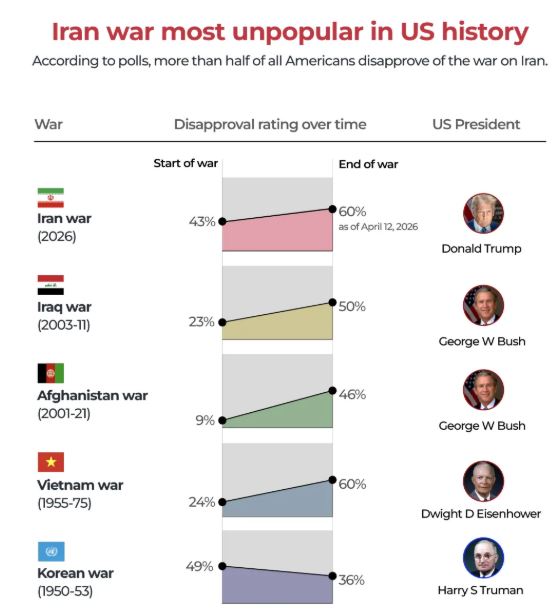
It took Vietnam years to reach 60 percent disapproval. The Iran war got there in six weeks.
By That’s Enough Opinion Desk
The infographic above should be a wake-up call for every elected official in Washington. It is not about casualties or costs or strategy. It is about something more fundamental: the will of the American people.
And the American people have spoken. They hate this war.
| War | Disapproval at End | Time to Reach |
|---|---|---|
| Iran War (2026) | 60% | 6 weeks |
| Vietnam War | 60% | Years |
| Iraq War | 50% | Years |
| Afghanistan War | 46% | Years |
| Korean War | 36% | Years |
Iran is now tied with Vietnam as the most unpopular war in modern American history – but Vietnam took years to get there. The Iran war did it in just over a month.
From 43% to 60% in Six Weeks
When the US and Israel launched their military campaign against Iran on February 28 – an action critics say violates the UN Charter, as it was not authorized by the Security Council nor justified as self-defense – disapproval stood at 43 percent.
By April 12, just 44 days later, disapproval had climbed to 60 percent.
That is a 17-point drop in support in less than two months.
Compare that to Iraq. The Iraq war started with only 23 percent disapproval. It took years of mounting casualties and growing public fatigue to reach 50 percent. The Iran war started with nearly twice that level of opposition – and then got worse.
What Makes This War Different
Why is the Iran war so uniquely unpopular?
1. The economic pain came instantly
Unlike previous wars, where the financial cost was abstract and deferred, the Iran war hit Americans at the pump immediately. Gas prices are up 50 percent. The national average is 4.48pergallon.InCalifornia,itisover8. Drivers feel that pain every time they fill up.
2. No clear justification
The stated reason for the war – stopping Iran from developing nuclear weapons – has been undercut by the fact that Iran has consistently denied seeking nuclear weapons and was in compliance with the 2015 nuclear agreement until Trump withdrew the US in 2018.
3. The speed of the conflict
Previous wars dragged on for years, giving the public time to adjust, to normalize, to accept. The Iran war has been a constant barrage of news: missiles, blockades, oil shocks, base attacks, civilian casualties. There has been no “calm” period to build support.
4. The allies are not on board
European allies have criticized the war. Germany has been publicly feuding with Trump over it. Even Gulf allies like the UAE have signaled their discomfort. When America fights alone, Americans notice.
The Iraq and Afghanistan Comparison
It is worth remembering that the Iraq and Afghanistan wars started with broad public support. After 9/11, Americans were united. The Afghanistan war began with only 9 percent disapproval. Iraq began with 23 percent.
Over time, as the wars dragged on and the promised victories never came, opposition grew. But it took years.
The Iran war never had that honeymoon period. It was controversial from Day 1. And it has only become more unpopular since.
What This Means for 2026
The infographic includes a reminder: the disapproval ratings are tracked alongside the presidents who oversaw each war. For Iran, that president is Donald Trump.
Trump is already facing a difficult political landscape. The economy is strained. Gas prices are high. And now, a majority of Americans oppose the war he started.
In the 2026 midterm elections, voters will remember. And they will vote accordingly.
The Bottom Line
Sixty-eight days into the illegal US-Israeli war on Iran, the American public has made its position clear. At 60 percent disapproval, this war is now tied with Vietnam as the most unpopular in modern US history.
The difference is that Vietnam took years to reach that level. The Iran war did it in six weeks.
The public has turned against this conflict faster than any war in generations. The question is not whether Americans oppose it. The question is whether Washington will listen before the cost – in dollars, in lives, and in political capital – becomes even greater.